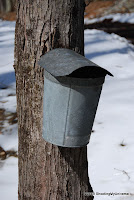
My first experience with sugaring was when I was about five years old. My brother and I were staying with friends in West Pawlet, Vermont and we had an opportunity to tag along with the Nelson family on their farm and gather sap. Then it was done by a tractor pulling the sap wagon through the woods in the snow. The men would ride along until we reached a bush and would disperse through the bush and gather the sap and bring it to the wagon. I was too young to be hauling buckets of sap through the woods, so I was just along for the ride. I remember coming back to the farm and emptying the wagon into the storage tank and the grandfather was there by the evaporator sugaring.

That’s me, on the left, Steve B of SMU and Taster A of Smells Like Grape. That was my friend, Mr. Bussinger in the middle and my brother John on the right. It was the Spring of 1971. Mr. Bussinger has a small sugar bush, about forty taps. Back then pipe lines were a novelty and only the big producers used them. We had galvanized steel buckets, an open arch (fire box) and a three stage pan.

We would gather the sap by hand carrying it through the woods in five gallon buckets. It was a small sugar bush so that was all that was needed. This was a wonderful, magical time in Vermont. The slow drum beat of the sap hitting the bottom of a freshly emptied bucket meant that the sap was running and it was spring time.
Sugaring involves lots of labor even for a backyard operation like Mr. Bussinger’s. There is wood to split and put in, trees to be tapped, sap to be hauled and hours and hours by the evaporator, feeding the ever-hungry arch. We were out in the weather and one of the things that would keep us warm was drawing off part of the partially boiled sap and having a warm glass. The smell of wood burning and the steam coming off the pan is just heaven. There is nothing else like it.
It has been 35 years since I’ve sugared myself. Time flies by fast with high school activates followed by college, moving to California and then to Colorado and now back to Massachusetts. Something was calling to me this year, my third winter back in New England. Perhaps it was that there was so much snow with no break from the cold much like the winters of my youth in Vermont. Perhaps this awoke old patterns, triggering a need to get back to the sugar bush to smell the arch, taste the sap and just see and hear the drip-drip-drip into a galvanized steel bucket. Perhaps it would give me reassurance that the daffodils will be erupting through the decaying leaves and the tree buds will be coming soon. Perhaps I needed it more this year then ever before.
“B, I found a sugar house in North Andover and they are boiling today. You coming along?” Poor B, she never knows how to plan the weekend. We got into the car and off we went.
Our destination was
Turtle Lane Maple Farm. When we arrived, we parked on the street as the website suggested and started walking to the back of the house where the sugar house is located. B wasn’t sure if we were on the right track, but this old woodchuck’s nose knows the smell of burning hardwood and the smell of sap boiling. I was off like a blood hound after a escaped prisoner.

Now I’ve heard rumors over the years of reverse osmosis systems, vacuum evaporators, and other High Tech aproaches to production. I have to set my purist, sentiment behind. Sugaring is energy intensive, even if it is a wood fired operation such as Turtle Lane. Using an RO system dramatically reduces the water content and shortens the evaporation time with less impact on the environment, and as long as the product is the same, I shouldn’t care.

Arriving in the sugar house, I felt right at home. This was definitely an top-notch operation, not only do they have a sugar house, but they have a good deal of wiz-bang doo-dads. Paul was conducting a tour, teaching a group of kids and adults all about sugaring, from the early history up to the latest techno-gadgets. But what comes through is that Paul and Kathy do enjoy the sugaring and the heritage. You don’t do this unless you love it. As I said before, sugaring is a lot of work, and it isn’t just what happens in the late winter and early spring. It's setting up the buckets and tube systems in the winter and packing wood in the summer and fall. Turtle Lane will go through 10 cords of wood. In my day, that would have been very low for their size operation. I'm sure that the RO helps.

The heart of the sugar house is the arch and the evaporator. The arch is a horrid task master, needing to be feed every ten minutes. The evaporator is monitored for temperature and sap level. The temperature of the sap is an indication of sugar content and as it reaches the sugar content of syrup, the temperature and density are closely monitored and when the conditions are right, it is drawn off to be finished under conditions that can be precisely monitored.

The value of Turtle Lane Maple Farm isn’t just the fine syrup products, but they are oriented towards education. Paul and Kathy open their sugar house to the public and provide informative talks sparing no detail about the history and technology of sugaring. We were very pleased to visit their sugar house on the first boiling day. I would imagine the syrup produced today will be “fancy” grade.

Sugaring will run all through March. Sap runs when the nights are cold and the days are warm. By April, the nights will be too warm for the sap to run. Until then, check the Turtle Lane website for their boiling schedule. If you are not near North Andover, you can do a search for “maple syrup, [state]” and you will find a link to that state’s maple producer’s association. This will help you find a sugar house to visit. Please do. There is so much to learn as this old Vermonter is happy to attest. If nothing else, you must smell this wonderful steam coming off of the evaporator!


 Okay, I cheated this week because this wine is technically $12 but, most of us should be able to find this for a little less...


 Mad Dogs and Englishmen
  The salient point is that I was thinking about our readers. I know times are tough, but I want our readers to find values without feeling like they have to run around barefoot with penguins and kangaroos. For me, that would be sad. Realizing that I have the same problem as many out there, what advice do I have to give? Be adventurous and try new things.