
Friday, November 16, 2007


Wednesday, November 14, 2007
Biodynamic Vineyards
 There seems to be a movement toward Biodynamic practices in many vineyards. This is a sustainable system that works with the life forces of materials and plants to create a system that is healthy, profitable and high quality without the use of chemicals or destructive practices. But Biodynamics goes beyond the concept of not using chemicals. It is a holistic approach that requires growers to pay close attention to the forces of nature in the vineyard.
The Biodynamic system combines the life force, the cycles of nature, preparations of organic teas and sprays, the nutrient system (consisting of composts and native yeasts and bacteria), the self regulating systems (use of diversified habitat of plants, animals and micro-organisms), traditional farming and stewardship of the land.
We learned about Benziger Family Winery and their Biodynamic practices before our recent trip to Sonoma placed them on our “must visit” list. It would be noble of us take the position that we should buy their wines because of their sustainable practices. The plain truth is that they make some very wonderful wines. It should be noted that Bonny Doon Vineyard also is a Biodynamic producer.
The Biodynamic principles may seem strange to some. As for me, I was trained in the science that created the atomic bomb and does not acknowledge the spirituality of man simply because they are not smart enough to look for one. I have learned in life that my body does better with a holistic approach than it does with drugs. I can reason that this is true for grape vines as well.
If you wish to learn more, visit www.benziger.com/tribute or http://www.biodynamics.com/
Tuesday, November 13, 2007
Does Wine Make You Fat?

For anyone thinking "yes, if you drink it with cheesecake" I want you to know that was a lowfat cheesecake featured in Taster A's previous post, and it was damn good if I do say so myself. I am not posting the recipe because it's an America's Test Kitchen recipe (slightly altered) and you can get it there. I just replaced some sugar with xylitol and used really good Greek yogurt instead of standard yogurt. I also used ricotta instead of cottage cheese.
Anyway, for me, I'm afraid the answer is yes: Wine does make me fat. I know there are a lot of articles out there that tout the health benefits of wine which I can't deny. And certainly compared to the average American diet, a Mediterranean diet rich in good fats, and antioxidants from olive oil and wine is a heck of a lot better for maintaining your weight than fast food and hard liquor. Sadly for me, if I add one glass of red wine per day to my diet, I gain weight. Taster A is the opposite (lucky duck!) which corroborates with findings from a study published in the Journal of the American College of Medicine1 which concluded the addition of two glasses of red wine to the evening meal does not appear to influence any measured variable which may adversely affect body weight or promote the development of obesity.
However, there is research to back up my personal observation: In an article published in the European Journal of Clinical Nutrition2, the researchers concluded that moderate alcohol consumption in the form of red wine and other beverages is associated with beneficial changes in blood lipids and fibrinogen that may help to reduce the CV risk factors, but that the body weight may increase. The most notable difference between these studies being that the first referenced was conducted entirely on male subjects, and the second was done with a mix of genders with the majority being female. So in conclusion, I will continue to enjoy a glass of wine on the weekends but I may not post Tasting Notes as prolifically as I would like. The good news is wine does make my cheeks nice and rosy.
1. Cordain, L, et al. "Influence of moderate daily wine consumption on body weight regulation and metabolism in healthy free-living males." Journal Of The American College Of Nutrition 16.2 (Apr. 1997): 134-139. MEDLINE with Full Text. EBSCO.
2. Hansen, A S, et al. "Effect of red wine and red grape extract on blood lipids, haemostatic factors, and other risk factors for cardiovascular disease." European Journal Of Clinical Nutrition 59.3 (Mar. 2005): 449-455. MEDLINE with Full Text.
Sunday, November 11, 2007
Presbyopia

As time goes on, it occurs to me that my arms are too short. Having discussed this with my ophthalmologist, he said that my eyes are 20/20. Whereas this may seem unreal to 80% of the people out there, why I lament about having 20/20 vision is that I once sported 20/15 vision. As to the length of my arms, my right arm seems to be shorter than my left arm. My ophthalmologist, (who seems like a kid, another symptom that I’m suffering from presbyopia*), very tactfully instructed me to go to the drugstore and pick up some reading glasses.
Taster B made a cheese cake. I recruited a slice here for the photo shoot with a few blue berries. The reading glasses are just part of the gag. I have been encouraging Taster B to post the recipe, but we are having a problem deciding what wine would go good with cheese cake. I’m going to take a chance on a bottle of Beaujolais.
*age-related problem with near vision: progressive reduction in the eye's ability to focus, with consequent difficulty in reading at the normal distance, associated with aging. It typically starts at middle age, and is due to age-related loss of elasticity of the lens.
[Late 18th century. < Greek presbus "man of advanced years"]
Saturday, November 10, 2007
Welcome to Smells Like Grape

Welcome to “Smells Like Grape”.
I’m delighted that Taster B has created this communication vehicle to document our journeys into the mysterious world of wine. Contrary to the “wine snob” mentality that is supposed to be the norm, we are finding friendly wine shops, wineries willing to share and educate, and lots of resources to help us develop a greater appreciation of wine.
Taster B and I both come from wine loving parents. Taster B grew up in California and I in Vermont. My first taste of wine was when I was 10 years old. It was a New York State Catawba served to me in a glass souvenir jigger with a Canadian Mountie on the side. My instructions were that this was an adult drink and I should sip it.
It was done in a rose style, and I remember it to be slightly bubbly, fruity and particularly to my liking. In today’s society, it would not be accepted to give a ten-year-old wine, but that is just our culture. My grandmother’s family immigrated to Springfield, Massachusetts at the turn of the century from Italy. My great-grandfather would take his four children to the rail yards to pick up grapes. The children’s feet would be scrubbed clean and they would stomp the grapes to make wine.
My grandmother told me the story of when she was greeted at school by her teacher on a winter’s day. “Why Josephine, you have such rosy cheeks this morning!” “Why yes, that is because papa gives us wine before we come to school.” As grandmother tells me, her teacher was shocked, but this was the family custom based on a different culture.
It would be years before I had my second taste of wine, most likely at Communion. But the understanding of wine and the making of homemade wine with my father has always been a part of my life.
My personal feelings are that wine is a most fortunate creation of nature, controlled by man. Above all, to me, wine represents civilization and family. I do not enjoy wine half as much alone as when I am with people. In recent times, due to the economic climate, I was forced to live 1100 miles from my wife. Alone in an apartment in Tennessee, I went the full 50 weeks on just one bottle of wine.
My Motto
Always remember, the best wine that you ever tasted is the best wine you ever tasted.
Saturday, November 3, 2007
It takes a thief to make luxury wines.

We had an opportunity to tour a winery facility in San Francisco at the end of harvest. We learned first hand what it takes to make truly first class luxury red wines.
This winery produces wines in small lots, 25 to 1200 cases and often fetch scores in the 90s from the Spectators and the Parkers. The wines are hand crafted. Each berry is inspected and sorted after going through the de-stemmer and before going to the crusher.

Fruit arrives at the winery from top quality vineyards from Santa Barbara up to Washington. The fruit is then put through a destemmer and sent down along a belt where the berries are sorted. Removing unripe, green berries, stems, leaves and other green bits prevents green vegetable and garlic like notes from creeping into the wine. The crushing process is done with a machine that can be set to break from 0% to 100% of the berries. This decision is made by the wine maker to determine the amount of tannins that will be immediately available during fermentation.
 The “must” is loaded into sterile T bins. The T bins hold one ton (T for ton) of fruit which will yield approximately two barrels of wine or 45 to 50 cases. The alcoholic fermentation takes place in these T bin. In small lot production, the must will begin to separate and the juice will flow to the bottom and the berries float to the top. This forms a dense cap on the top that must be “punched down” every four hours, around the clock. This breaks up the cap, oxygenates the must and keeps the fermentation going. It also helps the wine maker control the extraction of color and tannins from the seeds and skins.
 After the fermentation is complete, the wine is ready to be barreled. The free run is siphoned off from the bottom of the T bin. This is generally the higher quality wine. In large wineries, this is sent off to be finished as higher quality wines. In this operation, because the quality of the fruit is higher and the methods used, the wine will be carefully pressed. The winemaker must be careful not to press so hard that excess tannins are pulled from the skins and seeds. If the client has several barrels, the free run may be fermented separately and blended at the end with the pressed wine.
 Taking a sample of this future Bordeaux style wine from the press, we see the impression the thick Cabernet Sauvignon grape skins imparted on this ferment. Coming out of the press, the wine is cloudy, very acid, tart and quite fruit forward to say the least. But you can start to discern the characteristics of the wine. This wine already has the tannin structure, color, and flavor components of a really great wine.
Oak tannins are important to the structure and mouth feel of the wines. Wines without a good tannin structure will not be suitable for aging. This can be by design. A winery maker can impart a tannin structure with maturity at bottling time so the wine is drinkable in the near future, or give it a structure for aging. Much of this is dependent on the type of barrel. New barrels will impart heavy oak, used barrels will impart little oak but allow the wine to mellow in structure. Wineries such as Heitz, will start with an American barrel and switch to French oak to finish the barrel aging. Barrel sample are taking for time to time to determine if the wine is on the right path or needs an intervention to ensure that time and wine converge into the desired style.
American oak will give the wine a very strong oak, wild component. American oak barrels costs about $300 to $400 a piece whereas French oak barrels range from $850 to $1000. As mentioned for luxury wines, American oak is used intentionally for flavoring.

Once filled, the barrels are stacked in a temperature controlled rooms to control the secondary fermentation and aging. Oak aging allows a small amount of oxygen to enter the wine and transform the tannins into their final, drinkable form. At this stage, the tannins are still harsh, the wine is very fruit forward, sweet and a bit unbalanced. The oak will allow some the moisture to evaporate out of the wine. The barrels are topped off, (about a cup or so) every two to three weeks.
 At the end of fermentation, the winemaker has more decisions to make. Which type of barrel to use for final aging, how long to barrel age and what adjustments are needed for the final state of the wine. Now the wine tastes young, slightly unbalanced and still tannic. Our winemaker inserted a thief (glass tube device used to sample barrels) into a barrel and drew off a sample of Zinfandel that was at this stage. Taster B and I knew that we tasted a very special wine that will be a delight when it is ready to bottle. It has all of the components in place, the aromas, fruit forward, smoother tannins and good mouth feel that one would expect from a big Zinfandel.

When the wine is ready, final blending will take place. There are thirty to forty decisions that go into luxury wine production. From what varietals to what yeast, to what barrel to what label. The care and craftsmanship that goes into a luxury wine is extensive and labor intensive. For us, we gained a true appreciation for what it takes to make a great wine.

Thursday, November 1, 2007
Bartholomew Park Winery
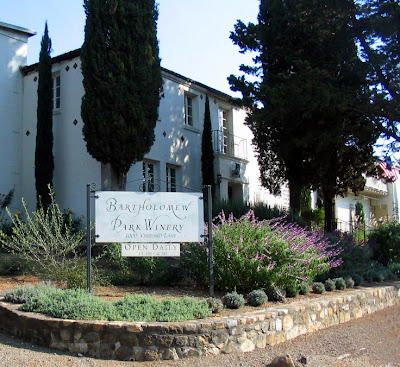
This winery is the only one we found so far that will ship to our “ship here at your own risk” state. Many wineries will not go through the trouble because it takes an agreement with a distributor in our state.
For a modest tasting fee of $5.00, we were enjoyed the following flight:
2006 Sauvignon Blanc (San Lucas Vineyard) $20.00
2004 Merlot (Desnudos Vineyard) $32.00
2004 Estate Syrah $38.00
2005 Zinfandel (Sonoma Valley) $38.00
2004 Cabernet Sauvignon (Kasper Vineyard) $38.00
2002 Cabernet Sauvignon (Sonoma Valley). $38.00
 These wine are hand made, micro-lot, single vineyard wines, which is what we were targeting on this trip. One thing I noticed while we were there was the local customers popping in and out. That give me a good feeling, like going to our favorite Greek restaurant and we are the only ones speaking English. Hey if the locals are buying wine there, something must be going right. I think it is the staff, the wines and the pricing. In addition, they have tasting notes that include pH, acidity, vineyard details, and all kinds of wine geek information.
The flight above gave us a chance to taste not only vintages, but vineyards. If you want to taste the difference a year and a vineyard can make, put this winery on your short list.
Kasper Vineyard faces directly southwest towards the San Francisco Bay. Located on a west facing slope, 700 feet above the valley flour in the Mayacamas Mountains. This bathes the vineyard in morning fog and is somewhat cooler. The soil is alluvial, deriving its complex composition from the sloping mountain above. These conditions make for a slower ripening grape which adds character and complexity.
2004 Cabernet Sauvignon
Bartholomew Park Winery
AVA: Sonoma Valley
Kasper Vineyard
Alcohol 13.8%
pH: 3.57
Acidity: 0.58g/100ml
Price: $38.00
Color: Ruby red
Intensity: Deep
Aromas and Flavors: Toasty, rose, spice, licorice, cherry, black plum skins, blueberry, allspice, mineral, green pepper, sage
Body: Full
Finish: Long
Summary: Very good value Cabernet, gently aged 15 months in French Tonnellerie Radoux barrels. The aromas and flavors came off in nice layers and just like a good book, it kept me captivated, waiting to see what would happen next.
Yup, we spent some of our coveted luggage space to bring back some of this winery's offerings.


