
We bring our wines to our eyes, noses and mouths for evaluation and enjoyment and we imagine how this wine may have been treated. When we think of oak aging, chances are that we get a picture similar to this.
Is this always what happens? Perhaps the wine industry would have us believe this. How many marketing impressions of wine have you seen that include oak dust, chips, staves, and beans? Not many and unless you are in the industry, you probably have never seen or heard of these. It would be pretty odd marketing.
Barrels like those shown come from French, American and Central European manufacturers. These barrels are becoming more and more expensive. Wineries are looking for ways to remain competitive. Competitive may mean remaining in a price point in spite of rising costs, producing a higher quality product in the price point the brand is in, or maximizing profits.
All of this is not very interesting to me as a consumer and not worth mentioning in this forum, but for one fact…barrel alternatives provide a way to provide a quality product while reducing the pressure on the forests.
Other than wood, wine is produced in stainless steel tanks, concrete tanks, and poly. They all have their merits. All of these are reusable. However it is the oak wood that imparts tannins, enhances roundness and helps stabilize color. Oak barrels also allow and exchange of oxygen in the wine.
A barrel has its strongest impact with its first use. Three times is about the max for most barrels. Thus a winery has to keep forking out for new barrels, trees get cut down and well eventually wine up somewhere as ash or trash. 
Extending barrel life
Wineries are starting to refurbish their barrels. Barrels are sent to the cooper and have their insides shaved and toasted. Thus a barrel gets a new life and the wine maker has a barrel at the fraction of the cost. This is a growing market segment for coopers.
Another method of extending a barrel’s life is to put a ring of staves inside the barrel. The cooper removes the top of the barrel and inserts a lining of new wood. This also is a cheaper alternative to new cooperage.
Other wood products
For those producers choose not to compete in a price point that will support the use of cooperage, there are alternatives and these alternatives are even finding their way into boutique wineries as well. Oak chips,flour, slats and spirals, are being used in barriques to help keep quality up without the expense of new barrels.
The skill of the winemaker must be expanded to use these materials. With oak, it’s the surface exposed to the wine in proportion to the volume of wine that is important. So the winemaker must decide if he wants to use flour with a high, almost impossible to control surface area, slats or “beans”. Beans offer a very predictable surface area and are easy to get into and out of barrels.
I am happy to see these products being used when they are used judiciously. There will always be a need for new cooperage and these products are made from the leftover lumber that is not suitable for making staves. This give a chance to produce a higher quality wines at a lower price point, barrels having longer life and there is less pressure on the forests. Seems good.
These products can be used in an attempt to mask an inferior wine. You can trick out a wine with turbo-chargers, chrome pipes, mag wheels and a Holly four-barrel, but you will still wind up with funky wine. Oak and toast will not make a bad harvest good. For a good example of this compare the 2005 and 2006 Ruffino Lumina Pinot Grigio. Flaws cannot be hidden. These interventions are a fact of the wine business. Keep it in perspective. It can bring variety to our world or it can bring homogeneity. Winemakers are using them. The marketers are spinning the dream. The public is buying.
What do you think? Is the dream important?
Saturday, May 10, 2008
Oak and Living the Dream

Tuesday, February 5, 2008
New Wine Shop, Adonna Imports and New Friends Tasting Italian Wines
There is a new wine shop in Salem, Massachusetts that our Passionate Foodie friend from the North Shore turned us on to. On the fifth of February, Eric of the Salem Wine Imports hosted an Italian wine tasting featuring seven of the wines from Adonna Imports. We even got to meet fellow North Shore Blogger Richard, ring leader of The North Shore Winers. This was our first visit to the new wine shop located on 32 Church Street in Salem, Massachusetts. The store is beautifully set up with a stunning offering of wines. Eric felt that Salem was right for a niche wine shop. There are lots of packies in the area, but having a wine shop where patrons can come in on a Tuesday night, have a tasting, socialize and procure some mighty fine wines is what Eric wanted. Salem Wine Imports has a great selection of Italian, French, Californian, Spanish wines as well as a wonderful selection of wines from Oregon and Washington.
 If you are looking for the unusual, the unknown, the hard-to-find; but most importantly high-quality wines at a good price, scamper on over, that’s exactly what you will find. Now, I’m a bit hard boiled when it comes to value. I saw some very good wines for the less than $20.00. How unusual? How about a Swiss Gamay? When was the last time you saw one of those? I'm not a Gamay fan, but this one had me taking another look. He also has wines in the $50.00 price point and above for those special occasions.
 The Tasting
Eric invited Eileen Wright of Adonna Imports to present a flight of six Italian wines from the Adonna portfolio.
Conte Vistarino 2004 Pinot Nero
Conte Visterino also from Lombardy has a long history of working with Pinot Nero dating back to the 1800's. The vineyards are located on The Count's vast Estate (mid 1500's) in the Oltrepo Pavese on the banks of the Po river. The winery is now run by his daughter Ottavia. Her objectives remain the same as her ancestors; create elegant, authentic wines that express their terroir. The Conte Vistario 2004 Pinot Nero is a lightly smoky, tannic little extra acid that one would expect from the region.
La Piane 2004 La Maggiorina
Le Piane is located in the Boca region of Italy in the lower Alps of the Piedmont.
The La Maggiorina is a Colline Novarsi DOC, district of Novara. The wine has a mixture of Croatina, Uva Rara, Vespolina and Nebbiolo. The name of the wine comes from the traditional Maggiorina system, where four vines are arranged in the four cardinal points, forming a cup. This is a newer DOC (1994) that also has a white wine made exclusively of Erbaluce grapes. The Maggiorina is a pleasant drinking wine with fruity and spicy aromas. The alcohol level is at 12% which I find to be typical of the Piedmont region. The wine maker Christoph Kunzli bought the property in 1988 from Antonio Cerri one of the last local wine growers of this almost forgotten region. The label states “dry red wine” which leads me to believe that it is the Rosso which would be Nebbiolo 30% min, Uva Rara max 40%, Vaspolina and/or Crotina max 30%. Yup, we brought one of these puppies home.
Martilde 2006 Bianco IGT "Gelo"
Italic Riesling grapes producing a still dry white wine with a simple profile is what's under the cork. The low yield and the advanced age of the vineyard guarantee the right level of ripeness (with grapes tinged with gold), resulting in a good structure and very mild acidity, which make it pleasantly full. Color a warm bright yellow, ample and compound nose, faintly citrusy. You can have it for the whole meal, with starters, first courses, or main courses of fish, poultry or white meats. (I’m thinking lobster.) On the label, is their male sheepdog "Gelo" in one of his favorite postures.
Martilde 2005 BonardaMartilde 2005 Bonarda is made entirely from Croatina grapes. A genuine, straightforward wine, ruby colored and with a simple clean nose, pleasantly reminding of small red fruit. This wine is not barrel fermented and will do well for enjoying now up to three years. It pairs well with soups, roasted meats, vegetables and light grillades.
Solatione 2004 Chianti Classico
Solatione is located in the heart of Chianti Classico region. The winery gets its name from the great exposition of the sun. The Vineyard is thirteen hectares, family owned and operated since 1972. Until 1991 the wine was sold to other vintners but in 1992 Fabio and Francesca (brother and sister) decided to bottle their own wines. The Chianti Classico is aged in Slovenic oak barrels for 12/16 months. This wine was definitely very delicious, well structured and firm tannins and very Sangiovese. Other Chianti Classico lovers were ooooing and aw-ing over this one. Taster B was also pleased with this offering with the only disappointment that it was sold out by the time we were ready to leave. (This is the one that got away!)
Redondel 2005 Teroldego
This winery is located in the Trentino owned and operated by a young winemaker Paolo Zanini He has a long family history in his vineyards. The vineyards are full of naturally maintained older vines with low yields and a small production. The wine comes from the Mezzolombardo in the Rotaliano plain.
A little about Adonna Imports
The company was started 3 years ago by Jeannie Rogers and Eileen Wright. Jeannie also owns Il Capriccio restaurant in Waltham, Massachusetts. Their portfolio consists of small winemakers who work well in the vineyards as well as the winery. Most of their producers are either 100% organic or working towards that goal. Jeannie has known most of the producers they work with for over 20 years. Jeannie also travels back to Italy frequently to source new winemakers. (I want that job!) Their portfolio 95% Italian but they do work with a few Austrian and one California winemaker.
Talking with Eileen, she tells us that they are having great success filling a niche market, catering to smaller wine shops and restaurants. The wines the get are from small producers and many (including some of the wines we tasted) are exclusive Adonna imports. Working with small lot producers and quality wines gives them the feeling of personal customer service and allows them to work closely with their clients.
Because their producers are small, many of their selections come in by the tens of cases, which is much too small of a quantity to be of interest to the large chain discount houses. Eileen tells us that she enjoys her work and particularly likes the idea of promoting the smaller, high quality producers.
As someone looking from the outside in, I get excited when I do business with folks like Eileen and Eric. Personalized service, quality products and I walk away with a feeling that we made some great friendships.
I also want to shout out to the Passionate Foodie for turning us to this. As a reward for getting through this posting, here is a tip. Eric is planning on having tastings most Tuesday nights. Check out his blog for details. The tip??? Salem Wine Imports encourages you bring your favorite tasting glass!
Thursday, January 31, 2008
What does chewy mean anyway?
 When I see it on a tasting sheet, I ask the pourer what it means. I get some interesting answers. “Well, it is a leather and tobacco quality that the wine has and it didn’t sell well, so we are changing the tasting notes.” Well, that’s not chewy.
Dr. Debs had an interesting post regarding wine-speak. Watching Frasier reruns, one may get the idea that wine aficionados are boorish snobs living in a world of their own, getting all excited about Chateau This and That while their more down to earth father pops open a cold beer.
In fact, my experience is quite the opposite. Wine people are actually down to earth, love what they are doing and are as personable as any other segment of the population.
But there is a terminology to wine. Can’t help it. Would it be as exciting if the reviews looked like this? “Purple liquid that tasted good. I smelled good too. 87”. No we need a vocabulary. "Dark ruby red wine with aromas of cherry, blackberry, black pepper and anise." So far, so good. "With sued-like tannins..." Okay, now you have a description for a Zinfandel. With a little practice, we learn what silky, sued and leather tannis are like in a wine. So tasting wine and comparing notes is important when learning.
One slang term I use is "packie". I try to remember to link to a definition to “packie” which is a Massachusetts term. Packie is slang for a package store or liquor store. I use this when I mean a little mom-and-pop corner liquor store that has beer, hard liquor and wine. This is in contrast to a wine shop. Here I mean a small wine store that specializes in wine. Then there is the big discount store. You get great deals, huge selections and discount prices.
To that degree, here is what I do when I come across a word I don’t understand. I get it defined. One of my favorite on-line places is www.onelook.com. This is a dictionary search engine that never lets me down.
Second, www.wikipedia.org. This is pretty good, but who know who put what were. I like to back this up with other on-line searches. In addition, to the right, we have Italian and French wine term links and a link to Robert Parker's glossary.
So what does “chewy” mean? You can find out here.
Friday, January 25, 2008
Size Matters at the Winter Wine Festival at the Wentworth

An evening at the Wentworth
The Wentworth Winter Wine Festival at the historic Wentworth Hotel in New Castle, New Hampshire is in full swing. Taster B and I decided to have a date night and drive the hour and a half up to the New Hampshire – Maine border to participate in the Riedel (pronounced Reed-L) wine glass demonstration.
Doug Cohn, North East Regional Sales Manager for Riedel introduced the Riedel family history and wine glass making tradition. Arriving in the room, at each place setting were the flight of four wines in four Riedel glasses and an empty “Joker” glass.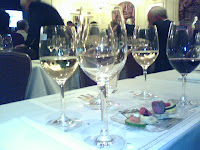 The Joker glass was actually good quality glass, according to Mr. Cohn. It is the wine glass used by the Wentworth. To me, it looked like a taller version of a glass that I would serve a Chardonnay or Sauvignon Blank in. Clean lines, thin stem, nice shaped bowl with a thin lip. The Riedel glasses will be mentioned with the wines.
The Riedel glasses were from the Vinum series. The Vinum collection, developed by Georg Riedel on the principle that the content commands the shape, is the "Vitrum-Vinothek" for every day use. They are machine made, have laser cut lips that are fire polished.
The wines tasted were introduced to us by a spokesperson from Vineyard Brands, wine importer of Villa Maria Estate wines. Presented were the Private Bin Sauvignon Blanc (Wine Enthusiast 90 pts), Private Bin Unoaked Chardonnay (Wine Review Online 90 pts), Private Bin Merlot/Cabernet Sauvignon (Wine Enthusiast 87 pts) and the Private Bin Pinot Noir (International Wine Cellar 88 pts).
Here were the wine/glass pairings in order of the flight:
Villa Maria Private Bin Chardonnay : Vinum Chablis 416/05
Villa Maria Private Bin Sauvignon Blanc: Vinum Riesling 416/15
Villa Maria Private Bin Pinot Noir: Vinum Burgundy 416/07
Villa Maria Private Bin Merlot/Cabernet: Vinum Bordeaux 416/0
Mr. Cohn instructed us to hold wine glass is by the stem below the bowl with two fingers and the thumb. A good glass is designed to balance so as to not draw your attention away from the wine. Try this at home with your wine glass, hold it and pivot it. Does it feel balanced or does it feel like top heavy or hard to pivot?
The Chardonnay was the first to try. We evaluated the color of the wine in the crystal. Naturally, it was aesthetically pleasing. The swirl action of the glass was nice. With a reasonable swirl, I didn’t worry that I was going to embarrass Taster B by losing the contents of my glass on the lady sitting next to me.
The sniff of this wine was very clean, fruit, melon, tropical fruit. The aromas were easy to get from the glass and discernable. Nice.
The next step was the taste. It was clean, fresh, unoaked. It was a very pleasant Villa Maria Private Bin Hawkes Bay Unoaked Chardonnay 2004. We talked about the flavors and aromas.
Then we were instructed to poor the contents into the Joker. We did the same evaluation. The Joker actually presented the wine very well. The aromas were not as concentrated but still okay. The swirl was a bit more cautious.
Next came the watershed moment. The taste. We took a sip and (this is exactly what happened) I thought, “This is much more acid.” Taster B looked at me and said, “hmmm, it tastes more acid.” What more can I say?
Between wines, Mr. Cohn had a few things to say. Enough to say that I poured that wine back and forth about five times just to make sure I wasn’t placeboing myself.
The Sauvignon Blanc was evaluated in the same manner. The differences were discernable. In the Riedel glass, aromas of grapefruit and to me, very much like juniper berry. I could not get the juniper berry in the Joker glass. Next was the Pinot Noir. The bowl on the 416/06 was pretty big and pulled in at the mouth. If you have friends that you want to train to swirl, this is the glass. You can swirl the bajeepers out of that wine and nothing will fling out. I tried. I almost ripped a rotator cuff swirling that wine. Not a drop was lost. Yup, you could train Aunt Millie and Uncle Harry to swirl with these bad boys.
The Pinot Noir was oaked. Fresh, green American oak, I thought too much. Many were enjoying the Pinot Noir, but it wasn’t my favorite. I could hear lots of “m-m-m-m-m-m-s” around the room, and I’m glad people like different wines. But for me, Oaky-smoky. So much so, I had a hard time finding the fruit.
I tried to pour the Pinot Noir into the Joker, but it smell too much of Sauvignon Blank so I just decided to continue this experiment at home. My mind is made up. Like Robert Mondovi and Robert Parker, Jr. and many more that have come before me, yes, I believe that Riedel has a good product. Yes, I want to experience and learn more. Yes, I believe I’d like to share that experience with our readers.
The Merlot/Cabernet Blend was nice, good tannin structure, good flavors, looked real sexy in the glass. MMM-mmm. Good stuff.
At the end of the event, we got to take the glassware home with us. We had a late dinner, I had Cod, Taster B had Salmon. Then it was back into the frozen winter night to drive an hour and a half home. It was a great night. If you have never done a tasting like this, treat yourself.
Friday, January 18, 2008
The Logic of Buying Wine
 Or "Why I don't use a point system"
The people that score wine know wine. They know how it is made and they really do a very good job over all. The reader wants to know if the wine he is considering is going to be good or not. But the reader really wants to know whether he should buy a particular wine or not. I have used published points to help me get started when learning about new wine regions, so don't get the idea that I think points are bad. Check this out. Forming a decision about a wine with Boolean two valued logic (yes or no, good or bad, right or wrong) is not how our decisions are formed. Even a three valued logic doesn’t quite describe the process either. "Yes, I want Merlot", "No, I don’t want Merlot" or "Maybe I want Merlot". And being stuck in a "Maybe" never gets anything done. Once you decide, “forget Sideways, I want Merlot”, you have flipped to a Yes state. If you decide No, then no it is.
I prefer an infinite valued logic, Yes at one end, No on the other and a full spectrum in between. For instance, you have a bottle of Merlot in front of you, you read the year, determine the producer and check for back for tasting notes. From your education and experience you conclude, “This is going to be good.” (High degree of Yesness.) Or you may say, “I don’t know, but I’m going to take a chance.” (More Yesness than Noness.) Or you may say, “I’m having flounder tonight, I think it will be too fruity, where is that Sauvignon Blanc?” (A high degree of Noness.) Or you may say, “Not even at gunpoint!”
In the end, you may do as I do… "Hey Taster B, what do you think of this one?” (Lots of Yesness, but need more data.) And that brings me to topic:
Wine scores. I was just reading an article on large wineries producing small lots to tap into a growing market. “Robert Parker, Jr. rated the Louis Martini 2003 Lot No. 1 Cabernet Sauvignon 91 points, and Martini says the micro-winery's 2004 wines have also received high scores from Parker, though Wine Spectator rated the 2003 Lot No. 1 only 82 points.” “Holy subjective wine scores, Batman!”
Yes, I like Robert Parker, Jr. Yes, I pick up a copy of the Wine Spectator when I’m in the barber shop and read it cover-to-cover and think, “Why the hell don’t we get this?” And I really enjoy reading my fellow bloggers’ postings. Some score and some don’t.
Why don’t I score even a Thumbs Up or Thumbs Down? (You spotted that is Boolean logic, didn’t you?) It’s easy. I write about the wines that I care to share with people. If I have a wine that I didn’t like, I wouldn’t want to share it with my friends, which includes you for reading through this article which is drier than an Alsace Riesling. We work hard, life is too short to drink bad wine and it is certainly too short to blog about it.
In closing, I spend all day as an engineer assigning numbers to physical universe stuff. When I get home, I just want to enjoy my wine without pulling out the meters. Speaking of meters, you should see the cool wine thermometer Taster B gave me for Christmas! I wonder how the new loft cellar is working? Let's see, 2003 Chateau Carignan 61.8 deg F. 2003 Vendemmia Barbaresco, 61.9 deg F. Bergess Napa Valley Cab, 61.9 deg F...
Thursday, January 10, 2008
Tick-tick-snap-tick, the Sound of the Future. (Say it taint so.)

I’ve been putting off this article for a month now. I think it is time I just bite the bullet and write it. It is much more fun to write about the last wine we discovered than to talk about problems. But it is part of what we are learning and therefore legitimate fodder for the blog.
Going into the wine store and selecting a wine, I still get the willies when I see a screw cap. I immediately think of Thunderbird, Annie Green Springs and Boones Farm. When I see a screw cap, it better have a jug wine under it, not my $23.00 bottle of Pinot Grigio!
Well, this is not the point. Producers are starting to push back against tainted wine. Wine drinkers are becoming more sophisticated and with today’s open communication lines, they are being less intimidated than in the past. “What if I complain to the sommelier about this wine and look like a fool?” Well, what if it isn’t earthy mushroom but wet cardboard and newspapers you smell? You may have a “corked” bottle. A bottle tainted with TCA (trichloroanisole).
TCA is a chemical produced by mold growing in a tainted cork. It is totally harmless, but it is detectable in one part per trillion! To put that in perspective, that is one drop of TCA for every 1,000,000,000,000 drops of wine. Most folks cannot detect this low of a level, but can detect 10 ppt. (In order to give you a sense of one part per trillion, this is like having your first name spoken once for one second in 43,000 years and you being able to hear it.)
In one case, TCA was blamed for an off-flavor component in eggs and broiler chickens. In that case, the chemical appears to have originated as a contaminant in feed and litter that was transformed to 2,4,6-TCA through microbial action. In the case of cork taint, it is presumed that 2,4,6-TCA originates from the chlorination of lignin [a wood component]-related compounds during chlorine bleaching in the processing of cork. (1 )
TCA poses no harm to humans, however it is the ruin of many a bottle. The cork industry will say that 7 in 1000 corks will foul a wine bottle, but the wine industry has claims as 1 in 10 bottles show some signs of being corked.
Wine Spectator reports the number typically ranges from 1 percent to 15 percent of all wines, depending on whether it comes from closure manufacturers, vintners or another source. Wine Spectator's Napa office tracks the number of "corky" bottles in tastings of California wines, and the percentage of defective corks routinely runs at 15 percent. At the magazine's California Wine Experience in 2004, the team of sommeliers who screened the wines for the seminars reported that the occurrence of “corky” bottles was 4 percent to 12 percent. The cork industry has a different estimate of cork failure: typically 1 percent to 2 percent.
TCA most frequently occurs in natural corks and is transferred to the wine in bottle from the cork closure. Other sources are pressure treated wood products and interaction with chlorinated chemicals. These non-cork generated TCA sources can find their way into vats, bottling equipment and through corks during aging. If a complete lot is contaminated, it is most likely the winery is contaminated, and that can spell disaster for the winery.
The presence of these compounds in cork can be associated with their use as wood preservatives and pesticides or with the use of chlorinated derivatives, commonly used as disinfectants of water, equipment, and work areas. Wineries must be constantly on the alert or a whole production lot could be lost. In order to eliminate whole lot contamination, wineries must rid themselves of pressure treated lumber products, some paints and sources of chlorine. Its sounds simple, but just try that in your home. This is why it is important to know your cellar contractor and know what materials are being used.
Mold Wars could be a solution?
There may be a biological solution to the problem. The use of Chrysonilia sitophila (a particular strain of mold) in cork stopper manufacture was studied and a simulation of the industrial processing of cork stoppers was performed. C. sitophila does not produce 2,4,6-trichloroanisole, guaiacol, or 1-octene-3-ol on cork slabs incubated for 66 days.(2) This approach is similar to using a dominate yeast in a fermentation or in the production of cheese. Alternative Closures
There have been strides made by the cork industry, but we are seeing new types of closures come to the market place. Synthetic corks or Stelvin closures and screw caps are taking the lead in alternative closures.
The Stelvin closure can be engineered for optimal oxygen permeation, but may impart a chemical taste to the wine. The Stelvin closures also do not degrade in the environment, meaning that we will see them washing up on the beaches in the near future. Screw caps have been around for a while, but are resisted by consumers.
Engineering a closure for wine does have its challenges. Screw caps work well for Seven Up. You are not aging Coca-Cola. We do not know what will be the result of aging Bordeaux style wines with screw caps.
We just purchased a Ruffino 2005 Pinot Grigio and a Ruffino 2006 Pinot Grigio. The 2005 came with a composite cork, the 2006 with a screw cap. It is coming, maybe faster than we may want.
I’m sad, say it ain’t so. There is something that I like about opening a bottle of wine, the anticipation. Will the cork break? Will it be everything I hoped for? Were my instincts right? Will it go with dinner? Will Taster B like it? And the soft pop of the cork as it is pulled out of the bottle. The wine goes into the glass and the first swirl and sniff…ah, it’s going to be a good bottle.
It just ain’t going to be the same with a screw cap. Sometimes I wonder if I’m just being neurotic? And what about our children? Will they ever know the joy of popping open a good bottle of wine or will they think I’m being an old fart messing around with “Old Reliable?”
Will they ever hear the pop of a real cork or just tick-snap-snap-tick?
Refs:
(1) Science News 121.25 (19 June 1982): 409-409. EBSCO.
(2) Role of Chrysonilia sitophila in the quality of cork stoppers for sealing wine bottles, Pereira, et. al., Journal of Industrial Microbiology & Biotechnology (2000) 24, 256–261. EBSCO.
Saturday, November 3, 2007
It takes a thief to make luxury wines.

We had an opportunity to tour a winery facility in San Francisco at the end of harvest. We learned first hand what it takes to make truly first class luxury red wines.
This winery produces wines in small lots, 25 to 1200 cases and often fetch scores in the 90s from the Spectators and the Parkers. The wines are hand crafted. Each berry is inspected and sorted after going through the de-stemmer and before going to the crusher.

Fruit arrives at the winery from top quality vineyards from Santa Barbara up to Washington. The fruit is then put through a destemmer and sent down along a belt where the berries are sorted. Removing unripe, green berries, stems, leaves and other green bits prevents green vegetable and garlic like notes from creeping into the wine. The crushing process is done with a machine that can be set to break from 0% to 100% of the berries. This decision is made by the wine maker to determine the amount of tannins that will be immediately available during fermentation.
 The “must” is loaded into sterile T bins. The T bins hold one ton (T for ton) of fruit which will yield approximately two barrels of wine or 45 to 50 cases. The alcoholic fermentation takes place in these T bin. In small lot production, the must will begin to separate and the juice will flow to the bottom and the berries float to the top. This forms a dense cap on the top that must be “punched down” every four hours, around the clock. This breaks up the cap, oxygenates the must and keeps the fermentation going. It also helps the wine maker control the extraction of color and tannins from the seeds and skins.
 After the fermentation is complete, the wine is ready to be barreled. The free run is siphoned off from the bottom of the T bin. This is generally the higher quality wine. In large wineries, this is sent off to be finished as higher quality wines. In this operation, because the quality of the fruit is higher and the methods used, the wine will be carefully pressed. The winemaker must be careful not to press so hard that excess tannins are pulled from the skins and seeds. If the client has several barrels, the free run may be fermented separately and blended at the end with the pressed wine.
 Taking a sample of this future Bordeaux style wine from the press, we see the impression the thick Cabernet Sauvignon grape skins imparted on this ferment. Coming out of the press, the wine is cloudy, very acid, tart and quite fruit forward to say the least. But you can start to discern the characteristics of the wine. This wine already has the tannin structure, color, and flavor components of a really great wine.
Oak tannins are important to the structure and mouth feel of the wines. Wines without a good tannin structure will not be suitable for aging. This can be by design. A winery maker can impart a tannin structure with maturity at bottling time so the wine is drinkable in the near future, or give it a structure for aging. Much of this is dependent on the type of barrel. New barrels will impart heavy oak, used barrels will impart little oak but allow the wine to mellow in structure. Wineries such as Heitz, will start with an American barrel and switch to French oak to finish the barrel aging. Barrel sample are taking for time to time to determine if the wine is on the right path or needs an intervention to ensure that time and wine converge into the desired style.
American oak will give the wine a very strong oak, wild component. American oak barrels costs about $300 to $400 a piece whereas French oak barrels range from $850 to $1000. As mentioned for luxury wines, American oak is used intentionally for flavoring.

Once filled, the barrels are stacked in a temperature controlled rooms to control the secondary fermentation and aging. Oak aging allows a small amount of oxygen to enter the wine and transform the tannins into their final, drinkable form. At this stage, the tannins are still harsh, the wine is very fruit forward, sweet and a bit unbalanced. The oak will allow some the moisture to evaporate out of the wine. The barrels are topped off, (about a cup or so) every two to three weeks.
 At the end of fermentation, the winemaker has more decisions to make. Which type of barrel to use for final aging, how long to barrel age and what adjustments are needed for the final state of the wine. Now the wine tastes young, slightly unbalanced and still tannic. Our winemaker inserted a thief (glass tube device used to sample barrels) into a barrel and drew off a sample of Zinfandel that was at this stage. Taster B and I knew that we tasted a very special wine that will be a delight when it is ready to bottle. It has all of the components in place, the aromas, fruit forward, smoother tannins and good mouth feel that one would expect from a big Zinfandel.

When the wine is ready, final blending will take place. There are thirty to forty decisions that go into luxury wine production. From what varietals to what yeast, to what barrel to what label. The care and craftsmanship that goes into a luxury wine is extensive and labor intensive. For us, we gained a true appreciation for what it takes to make a great wine.


1 comments:
Post a Comment